Showing posts with label Demeter Sinis. Show all posts

Friday, November 14, 2014

Demeter Sinis (Batch 03): Recipe

This was my third time brewing Demeter Sinis, the winter seasonal in the Demeter series.  As I have been pretty happy with it since the first batch, I didn't really change anything up here.  I'm also pretty excited as it has been a long time since I've had "straight" Demeter Sinis available.  This is due to the fact that last year's Batch 02 was all fruited, with the pomegranate portion getting kegged and the cranberry portion was bottled.  Thankfully I do still have a few bottles of the latter.  

As I've cleaned up my temperature control equipment for the season making way for a steep drop-off in brewing over the next few months (twin boys coming soon to the Thorpe family!), I decided to just ferment this one at room temperature.  In my experience, I've gotten yeast-driven character that's pretty similar no matter the temperature I use with my current yeast/Brett blend, it just takes a bit longer when fermenting in the 65-70*F range as opposed to the 75-80*F range.  I really do need to do some actual split-batch experiments with temperature next year though.

The recipe for the full batch is as follows:

Batch Number: 96
Brew Date: October 4, 2014
Bottle Date: November 2, 2014
Batch Size: 10 gallons
OG: 1.045 (estimated)
FG: 1.002 (estimated)
Fermentation Temperature: 65-70* F (room temperature)
IBU: 27.0
ABV: 5.5% (est.)
SRM: 17

Mash: Single infusion for 60 minutes at 154* F.
Boil: 60 minute

Fermentables

7lb 8oz Belgian Pilsner
4lb 0oz Wheat Malt
4lb 0oz Wheat, Flaked
1lb 0oz Acid Malt
0lb 12oz Rye Malt
0lb 8oz Oats
0lb 8oz CaraMunich
0lb 8oz Carafa II
0lb 4oz Chocolate Malt

Salts & Water

5.5g Calcium Chloride (all added directly to the kettle)
4.3g Gypsum (all added directly to the kettle)
6.1g Sodium Chloride (all added directly to the kettle)

All of the salts are added directly to the kettle to achieve the ultimate water profile that I am looking for. Acid malt is being used to get the mash pH almost to where I wanted it.  I also added 4mL of lactic acid to the mash.

Resulting water profile (based on EZ Water Calculator v3) is as follows:

Mash pH (est.): 5.21
Calcium: 78
Magnesium: 12
Sodium: 50
Chloride: 127
Sulfate: 70

I also added 5.5mL of lactic acid to the sparge water to get the pH of that liquor to 5.2.

Hops

1.0oz Nugget (pellet, 13.3 AAU) at 60 minutes
1.0oz Willamette (leaf, 7.5 AAU) at flameout

Other

2.0 tsp. Wyeast Yeast Nutrient at 10 minutes
6.0g Lavender, dried, at flameout*
1.0g Black Cardamom, at flameout

Yeast

Full batch used Ambrosia Blend 005 (now the seventh generation) from the cake of an September 27, 2014 batch of Demeter Facile.  Per yeast calculator.com, I needed 160 billion cells for the entire batch.  At 40-60% solids, this would mean 250mL for the whole batch.  I went with 500mL, as I was pulling from a wine thief and didn't have the best vie, and I'd rather overpitch than underpitch, and didn't have time to let everything settle out before measuring.

Notes

11.02.2014: Bottled around 9 gallons, aiming for 3.0 volumes of CO2 based on the tastybrew.com priming calculator.

Monday, December 16, 2013

Demeter Sinis (Batch 02): Recipe

This was my second time brewing Demeter Sinis.  The first time I brewed this beer was nearly a year ago.  Overall, I was quite pleased with that batch, and still have a few bottles left.  My one complaint is that while I like what the blend of mixed-ferment saison dregs has done to the beer over time, the body has gotten a bit too thin.  To counteract that, this time I'm adding some additional chloride and sodium to the beer to emphasize the malt a bit more, and have also upped the mash temperature a bit to see if I can retain a bit more body.

Finally, last time I aimed for 3 volumes of CO2, and that made the mouthfeel a bit crisper than I would like.  While I think I'll be kegging most of this batch, I'll likely go down to 2.5 volumes, a target I'll probably stick to in the future when conditioning dark saisons, and keeping the 3.0+ volumes solely for blonde saisons, and particularly ones with Brett.

I also have a few more ideas for this beer, including a version aged on red wine-soaked oak cubes.  Since my mash tun can only handle about 20 pounds of grain, my limit for this run is about 7.5 gallons.  I decided to do 5 gallons with pomegranate, and then do 2.5 gallons on the side with cranberries.  Soon enough, I'll do a thicker mash to see if I can get to 10 gallons and do half straight and half with red wine oak cubes.

Winter brew day.  Photo courtesy of Thorpette.

The recipe for the full batch is as follows:

Batch Number: 74
Brew Date: December 14, 2013
Bottle/Keg Date:
Batch Size: 7.5 gallons
OG: 1.065 (estimated)
FG:  1.004 (estimated)
Fermentation Temperature: 65* F
IBU: 31.7
ABV: 7.8% (est.)
SRM: 24.5

Mash: Single infusion for 60 minutes at 153* F.
Boil: 60 minute

Fermentables

7.5 lb Briess 2-Row
4.5 lb White Wheat Malt
3.0 lb Wheat, Flaked
1.0 lb Acidulated Malt
12oz Rye, Flaked
12oz Wheat, Torrified
8oz Oats, Flaked
8oz CaraMunich
9oz Carafa II
4oz Chocolate Malt

Salts & Water

8.0g Calcium Chloride (all added directly to the kettle)
7.0g Baking Soda (all added directly to the kettle)
2.0g Gypsum (all added directly to the kettle)

All of the salts are added directly to the kettle to achieve the ultimate water profile that I am looking for.  Acid malt is being used to get the mash pH where I want it.

Resulting water profile (based on EZ Water Calculator v3) is as follows:

Mash pH (est.): 5.35
Calcium: 89
Magnesium: 12
Sodium: 47
Chloride: 95
Sulfate: 51

Hops

2.0oz Willamette (7.5 AAU), leaf, at 60 minutes
1.0oz Willamette (7.5 AAU), leaf, at flameout

Other

Whirlfloc (2) at 10 minutes
1.5 tsp. Wyeast Yeast Nutrient at 10 minutes
6g Lavender, dried, at flameout*
2.5 pounds of pomegranate juice and seeds,
along with a glass of Demeter Sinis (Batch 01)
1.0g Black Cardamom, at flameout

Pomegranate for 5 gallons of the batch.  For this, I took the seeds and juice from 10 pomegranates, which came to about 2.5 pounds of fruit/juice.

Cranberries for 2-2.5 gallons of the batch.  I juiced the cranberries, which yielded approximately 300mL of juice.

Both types of fruit were added to primary, with the pomegranate going into the bucket with 5 gallons, and the cranberries going into the 3-gallon Better Bottle.

* I wanted 20g of Lavender, but ran out.  I ordered more for the straight batch that I'll do in a few weeks.  I'm not as worried about this batch, since the fruit will provide plenty of background.

Yeast

Blend of Wyeast 3725, Crooked Stave, and miscellaneous mixed-fermentation saison dregs using the cake from Demeter Spectre.

I also added the dregs from a bottle of the first batch of Demeter Sinis.

Notes

12.14.2013: Gave the smaller portion 30 seconds of pure O2, and the larger portion got 60 seconds.  The gravity was lower than expected, coming in at 1.055.  I'm guessing this goes back to the sparge, where I was in a bit of a hurry due to the chilly weather and snow, which created additional obligations.  For yeast calculations, I kept the gravity at 1.065, as I'm not sure how high the fruit took each batch.

Based on Mr. Malty's calculator, I used 110mL of the Farmhouse Mild cake for the 5 gallon portion, and 45mL of the Farmhouse Mild cake for the 2 gallon portion.

12.15.2013: Strong fermentation for both portions of the batch.  Each one sitting at about 65* F.  As you can see in the picture below, the critters have already sucked the pomegranate seeds dry and they've been taken up into the krausen:


01.25.2014: Bottling day for the cranberry portion.  The pomegranate portion previously went on draft.  I haven't done a separate write up for it as of yet, as I feel like the pomegranate just added a bit of tartness, and the blend I'm using already adds some tartness, so it's difficult to tell it's there.  One thing is that as the beer warms, there is a slight hint of the pomegranate membrane, some of which inevitably got into this.  If I was doing this again, I would definitely use either pomegranate juice (store bought or self-juiced), as that would be quite a bit easier, even though it was cool watching the yeast strip away all the flesh from the pomegranate seeds.

Cranberry portion bottling: Two and a half gallons. FG of 1.006. Final pH of 3.5. Aiming for 2.75 volumes of CO2. Added sugar directly to bottles, uses 5.5g for each 750mL bottle and 2.75g for each 375mL bottle. Ended up with ten 750mL bottles and three 375mL bottles.

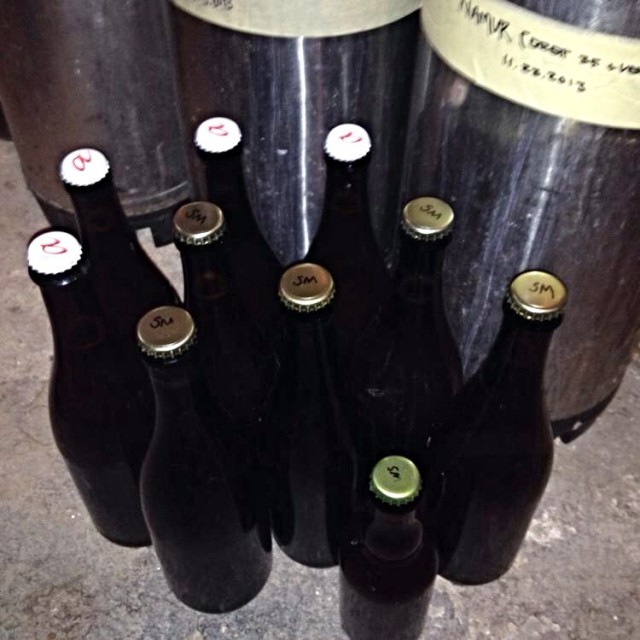
One thing to add is that this was also my first chance to use my custom "ambrosia" caps, which Amy got me for Christmas:

Difficult to see, but ambrosia "a" logo caps on the left.

Monday, February 11, 2013

Ambrosia Demeter Sinis: Recipe


Base Recipe

Batch Number: 57
Brew Date: January 21, 2013
Bottle Date: February 10, 2013

Batch Size: 5 gallons

OG: 1.061 (est.)
FG: 1.006 (est.)
IBU: 0
ABV: 5.2% (est.)
SRM: 23.2
Mash: Single infusion for 60 minutes at 151 F.
Boil: 60 minutes

Fermentables

5lb 0oz French Pilsner
3lb 0oz White Wheat Malt
2lb 0oz Wheat, Flaked
0lb 8oz Red Wheat, Torrified
0lb 8oz Rye, Flaked
0lb 4oz Carafa II
0lb 4oz Roasted Barley
0lb 4oz Special B Malt
0lb 2oz English Chocolate Malt

Hops

1.5oz East Kent Goldings (5.8 AAU) at 60 minutes
0.5oz East Kent Goldings (4.5 AAU) at 5 minutes
0.5oz East Kent Goldings (4.5 AAU) at Flameout

Other

14g Lavender at 2 minutes
0.75g Black Cardamom at 2 minutes
1.5oz Red Wine-Soaked Medium Toast Hungarian Oak Cubes during primary

Yeast

Hill Farmstead Blend (Dregs from Hill Farmstead Arthur, Clara, and Vera Mae).  This is the third generation for this blend, after previously having been used in Repeating Numbers and then Demeter Auran.

Notes

01.22.2013 - Fermentation is active after approximately 12 hours.  At 24 hours, the airlock is bubbling away.  Used approximately 4 large spoonfuls of the cake from Demeter Auran, which was still showing a bit of activity after 9 days.  Fermentation is at approximately 65 F ambient.

02.10.2013 - Bottled approximately 5 gallons with 150 grams of table sugar, aiming for 3.0 volumes of CO2.  Tastes great out of the fermenter.  The cardamom was a bit strong a week ago, but has faded, and should be at about the right level by the time carbonation is complete.