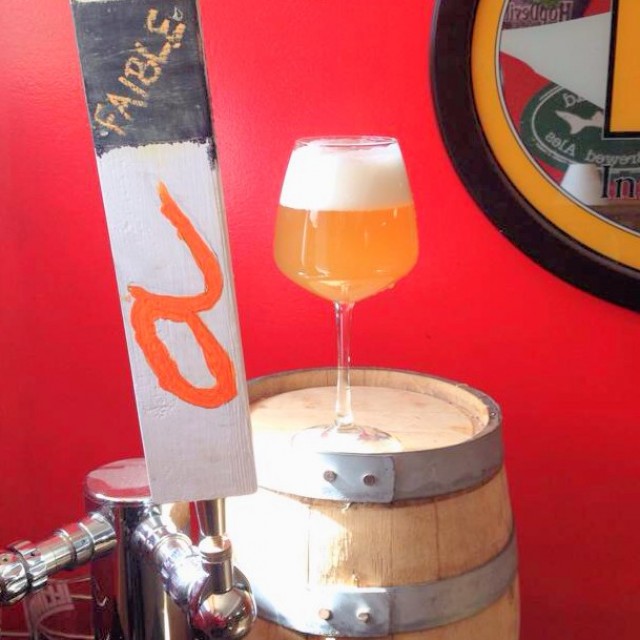
It's been a long time coming as this keg has (unfortunately) long since kicked, but below are the tasting notes for the second batch of Saison Faible (recipe here), which is designed to be a light, easy-drinking saison. This is the portion of the batch that was fermented with Wyeast 3726 Farmhouse Ale. The beer was carbonated in the keg to approximately 3.0 volumes of CO2.
Appearance: Heavy, creamy head atop a hazy golden beer. Great retention and heavy lacing on the way down. One of the best-looking beers that I've brewed. As I think I have mentioned in the past, I love the rustic look of a hazy saison as opposed to one that pours crystal clear.
Nose: Strong with notes of mango, orange zest, honey, and a bit of pear. Almost a light, vanilla-like character as it warms.
Taste: Similar to the nose, but actually has a bit of tart cherry in the background. It's not a sour beer by any means, but there is a very faint tartness through the finish. Just a hint of earthy spice.
Mouthfeel: Full and creamy up front, but finishing quite dry. The oats and wheat added plenty of proteins, and it seems like this yeast produces plenty of glycerol, together leading to a lovely feel. At the same time, finishing around 1.002-1.004 doesn't leave much there, and the finish is accordingly quite dry.
Overall: Not much I would change about this one, and I'm looking forward to brewing another batch. This is something I plan to have on tap year round at the future tap room, and is making me think twice about doing all oak fermentation with Brett in everything. While there is undoubtedly a bit of Brett going to work here (given that there was a pellicle at the time of kegging), its character is relatively muted compared to the Saccharomyces and hops.
A blog devoted to craft beer and homebrewing, with an emphasis on saisons, wild ales, and other farmhouse beers. Home to recipes and tasting notes for Ambrosia Farmhouse Ales.
Showing posts with label Saison Faible. Show all posts
Monday, October 19, 2015
Saturday, July 18, 2015
Saison Faible (Batch 02): Recipe
This was my second time brewing Saison Faible, which is intended to be a light, fruit- and hop-forward saison without the funk and light acidity of Farmhouse Mild. For this one, I wanted to experiment with a few different yeasts, so half the batch was fermented with non-saison Belgian yeasts. It was a 20-gallon batch, so I ended up with around 5 gallons of portions fermented with each of the following: Wyeast 3724 (Dupont, Wyeast 3726 (Blaugies), White Labs 510 (Bastogne, which is Orval's primary-fermentation strain), and White Labs 550 (Achouffe, which is, or at least was, Jolly Pumpkin's primary strain).
After this, I plan to start experimenting a little bit more with European and old-school American hops, as I'd like to see how much of the fruity profile of many of my beers is a result of the yeast and bacteria strains I use, and how much is related to the generally-copious amounts of American and Southern Hemisphere hops I use at flameout.
Here are the full details on the batch:
Batch Number: 99
Brew Date: June 15, 2015
Keg/Bottle Date: See notes below
Batch Size: 20 Gallon
OG: 1.040 (est.)
FG: 1.003 and the 3724 and 3726; 1.008 for the 510 and 550 (measured, prior to Brett/dreg additions)
Fermentation Temperature: See notes below
IBU: 32.0-66.0 (wildly-different estimates from BrewCipher based on the hop stand, and I also don't know how much the aged 60-minute hops affected things)
ABV: 4.9% (est.) for the 3724 and 3726; lower for the 510 and 550 (until I decided to add dregs to each)
SRM: 3.0
Mash: Single infusion for 60 minutes at 152* F
Boil: 60 minute
Fermentables
14lb 8oz Dingemans Belgian Pilsner (46%)
9lb 8oz Flaked Wheat (30%)
2lb 0oz Munich (6%)
2lb 0oz Flaked Oats (6%)
1lb 11oz Acid Malt (5%)
1lb 0oz Flaked Rye (3%)
1lb 0oz Honey Malt (3%)
Salts & Water
1.0g Calcium Chloride (all in the boil kettle)
13.1 Gypsum (all in the boil kettle)
17.5g Sodium Chloride (all in the boil kettle)
Resulting water profile is as follows:
Mash pH (est.): 5.30
Calcium: 67
Magnesium: 12
Sodium: 75
Chloride: 123
Sulfate: 99
Hops
8.0oz Styrian Bobek (pellet, 3.9 AAU, 2.5 years old), at 60 minutes
1.0oz of Galaxy (pellet, 15.0 AAU), after flameout*
4.75oz of Mosaic (pellet, 11.6 AAU), after flameout*
4.25oz of Calypso (leaf, 12.0 AAU), after flameout*
* No hops right at flameout. Turned the burner off and let it cool to 190*F. Added the hops at that point for a 90-minute hop stand, with final temperature around 150*F.
Other
4.0 tsp. Wyeast Yeast Nutrient at 10 minutes
Yeast
Notes
14lb 8oz Dingemans Belgian Pilsner (46%)
9lb 8oz Flaked Wheat (30%)
2lb 0oz Munich (6%)
2lb 0oz Flaked Oats (6%)
1lb 11oz Acid Malt (5%)
1lb 0oz Flaked Rye (3%)
1lb 0oz Honey Malt (3%)
Salts & Water
1.0g Calcium Chloride (all in the boil kettle)
13.1 Gypsum (all in the boil kettle)
17.5g Sodium Chloride (all in the boil kettle)
Resulting water profile is as follows:
Mash pH (est.): 5.30
Calcium: 67
Magnesium: 12
Sodium: 75
Chloride: 123
Sulfate: 99
Hops
8.0oz Styrian Bobek (pellet, 3.9 AAU, 2.5 years old), at 60 minutes
1.0oz of Galaxy (pellet, 15.0 AAU), after flameout*
4.75oz of Mosaic (pellet, 11.6 AAU), after flameout*
4.25oz of Calypso (leaf, 12.0 AAU), after flameout*
* No hops right at flameout. Turned the burner off and let it cool to 190*F. Added the hops at that point for a 90-minute hop stand, with final temperature around 150*F.
Other
4.0 tsp. Wyeast Yeast Nutrient at 10 minutes
Yeast
- Wyeast 3724: Pitched into a water bath at 72*F. At 12 hours, bumped to 74*F. At 72 hours, bumped to 76*F. All temperatures are setting on controller with a 1*F differential. At 5 days, bumped to 78*F. Removed temperature control at 8 days.
- Wyeast 3726: Pitched into a water bath at 72*F. At 12 hours, bumped to 74*F. At 72 hours, bumped to 76*F. All temperatures are setting on controller with a 1*F differential. At 5 days, bumped to 78*F. Removed temperature control at 8 days.
- White Labs 510: Fermented in the basement at room temperature, generally 67-68*F.
- White Labs 550: Pitched into bath at 72*F. At 12 hours, bumped to 74*F. At 72 hours, bumped to 76*F. All temperatures are setting on controller with a 1*F differential. At 5 days, moved to ambient garage temperature, generally 70-75*F.
06.19.2015: Starters:
06.15.2015 - 06.23.2015: See "Yeast" section above for temperature adjustments.
06.15.2015: Bastogne finished at 1.008 after sitting for 15 days at 67-68*F ambient temperature. Pint of slurry harvested. Very clean with little sediment. Flavor is a bit leafy and earthy in the background with some faint phenolics. Apricot and peach up front.
550 finished at 1.008. Lighter profile than the Bastogne. A bit of pear and honey with a light touch of bread dough. Very faint fruity notes, quite a bit less than the Bastogne in that area. Fuller mouthfeel than the Bastogne despite finishing a bit drier.
Blaugies is extremely carbonated for coming out of primary. Sitting at 1.004. Dupont is also sitting around 1.004. Both are fairly tropical and have notes of peach and apricot, but the Blaugies is more subdued. Many of the fruity aspects are likely coming from the hops.
07.06.2015: Transferred the Bastogne version to a keg to begin carbonation. Not sure I like the combination of the fruity hops with the more floral, earthy, and leafy yeast. I'll have to try this again with Noble hops, as those will complement those yeast aromas/flavors.
07.07.2015: Decent pellicle already going on the Blaugies fementor not too many days after it was removed from the hot water bath. (Obviously, even filling these buckets with StarSan solution and letting them sit for a while doesn't get rid of all the bugs I have in the buckets and lids.) My theory on the sudden Brett takeover is that the saison yeast really takes over at higher temperatures, but as the temperature is lowered and the gravity drops, it becomes more dormant and the Brett takes over.
07.09.2015: Added the dregs from two year-old 375mL bottles of Bam Biere to the WLP550 version, as I wasn't terribly happy with the profile, and it has been a long while since I've used Jolly Pumpkin dregs.
07.18.2015: The Bastogne version was on tap, but I'm still not happy with how the yeast character clashes with the hops, so I pulled the keg and plan to add some Orval dregs to let those go to work over time, which will also allow for the hop aromatics to fade a bit.
11.09.2015: Added Orval dregs to the Bastogne keg.
03.04.2016: Added dregs from a bottle of 03.11.2014 Jolly Pumpkin Luciernaga to the Bastogne keg.
05.31.2016: Was never happy with the 550 version, so that one ended up going down the drain, as I didn't have anything to blend it with that I thought would actually work out. I'm likewise not particularly pleased with the Bastogne version, but I'm still holding out hope for further development with that one.
Saturday, February 22, 2014
Saison Faible: Tasting Notes
Saison Faible is the clean petit saison that I brewed for the first time recently, using solely Saccharomyces as opposed to the blend of Saccharomyces, Brettanomyces, and bacteria that is used in my rustic saison, Farmhouse Mild. Of course, I can never entirely get away from wild fermentations, so I took the other 5-gallon portion of this batch and fermented it with Ambrosia Blend 003, which utilizes the grown up dregs from a bottle of the November 2013 batch of Hill Farmstead Anna.
This batch of Faible was fermented with East Coast Yeast Saison Brasserie Blend (ECY08), which is described as "both fruity and spicy characteristics accompanied by dryness." It was hopped with Calypso, Citra, and Simcoe.
Appearance: Hazy golden color with just a touch of a peach hue. Dense, rocky white head with good retention and plenty of lacing as it fades down to a thin cap and collar.
Aroma: Slight tropical fruit notes along with some bread dough. A very slight hint of bubblegum. Some mild pear and honeydew.
Flavor: Juicy Fruit is what immediately comes to mind for me. Tropical fruit and very light orange peel in the background. Honeydew and melon. A touch of pepper and a very mild lingering bitterness in the background. Dry with a hint of tartness through the finish. As it warms, there's a touch of bread dough in the background. I've noticed quite a bit more of the bread dough if I have nearly any other beer ahead of this one.
Mouthfeel: Light with effervescent carbonation. Just enough body to keep it from seeming thin. A slight lingering bitterness through the finish. Very faint pepper in the aftertaste.
Overall: I'm very pleased with how this one came out, especially with it being my first time using this strain/blend. I'm very curious to see how this is going to perform in subsequent generations, as well as with a bigger beer. I of course had to mix it with something wild, so I am already using the second generation of this blend, combined with Brett C and Brett Trois, in the new batch of Demeter Auran.
Saturday, January 25, 2014
Saison Faible: Recipe
This is the same base, basically, as Farmhouse Mild, with a different name, Saison Faible, as this time I'll be aiming for a character. The last few times batches of Farmhouse Mild have started with Wyeast 3725 and mixed-ferment saison dregs. Eventually, that also got some Crooked Stave dregs. I like the blend, as it's a bit more rustic and tart, but it's not what it was originally with just the saison dregs. So, I grew up the dregs from the a few other saisons, and used those for half of this batch. For the other half, I used a fresh "vial" of East Coast Yeast Saison Brasserie (ECY08).
For this one, I again kept things relatively similar, just changing up the yeast. This is again a 10-gallon batch.
The recipe for the full batch is as follows:
Batch Number: 77
Brew Date: January 20, 2014
Bottle/Keg Date:
Batch Size: 10 Gallon
OG: 1.045 (measured)
FG:
Fermentation Temperature: 67 F (saison dreg portion) / 80 F (ECY08)
IBU: 29.4
ABV: 5.0% (est.)
SRM: 4.1
Mash: Single infusion for 60 minutes at 154 F.
Boil: 60 minute
Fermentables
8lb French Pilsner
4lb White Wheat Malt
2lb Wheat, Flaked
1lb 8oz Munich Malt
12oz Acidulated Malt
8oz Oats, Flaked
8oz Rye, Flaked
Salts & Water
1.0g Calcium Chloride (all added directly to the kettle)
2.5g Gypsum (all added directly to the kettle)
5.0g Sodium Chloride (non-iodized) (all added directly to the kettle)
The adjustments were a bit different than the last batch, but should result in a fairly similar profile.
Resulting water profile (based on BrewCipher) is as follows:
Mash pH (est.): 5.49
Calcium: 49
Magnesium: 12
Sodium: 43
Chloride: 78
Sulfate: 53
Chloride / Sulfate Ratio: 1.48
Hops
1.0oz Calypso (16.0 AAU), leaf, at 60 minutes
2.0oz Calypso (16.0 AAU), leaf, at flameout
1.0oz Citra (12.9 AAU), leaf, at flameout
1.0oz Simcoe (12.4 AAU), leaf, at flameout
Other
2 tsp. Wyeast Yeast Nutrient at 10 minutes
Yeast
Saison dregs / Ambrosia Blend 003 (5 gallons)
East Coast Yeast Saison Brasserie (ECY08) (5 gallons)
Notes
01.20.2014: On January 5, 2014, I added 100mL of 1.020 wort to the dregs of some saison bottles and shook fairly regularly. On January 9, 2014 (10:00 am), I added 350mL of 1.020 wort to the mason jar and put it on a stir plate. Several days later, I added 1L of 1.020 wort to the starter, put in a 2L flask, and put on the stir plate. Finally, on January 19, 2014, I decanted and added 1.6 L of 1.040 wort to the starter and kept on the stir plate.
The East Coast Yeast was put together on December 3, 2013, and since those containers contain 300-400 billion cells, I didn't think a starter was absolutely required, but to be safe, I added the contents to 750mL of 1.040 wort in a 1L mason jar to get things going about 24 hours before pitching.
Each initially got 30 seconds of oxygen after pitching. The saison dreg portion is out at room temperature in the basement somewhat near the boiler, and should sit around 67 F. The ECY08 is pitched around 68 F and is sitting in a plastic bin with an aquarium heater. Both have bucket lids on loosely.
01.22.2014: Krausen has fallen on ECY08 at 36 hours. Was at 80 at 24 hours after turning heater to 74 at 12 hours. Saison dreg krausen strong at 24 and still going at 36 hours. A bit worried that the ECY08 shot up too quickly; need to add a separate temperature controller to the aquarium heater.
01.23.2014: At 72 hours, most of the saison dreg krausen had fallen as well, so closed the lid. Will close lid on ECY08 soon.
01.31.2014: Here's a picture of the saison dreg version at nearly two weeks:
02.09.2014: Transferred the ECY08 version to a keg to start carbonating. FG is 1.005.
02.12.2014: Tapped ECY08 version. Preliminary thoughts are that it has a nice Juicy Fruit character with some mild citrus and a very mild background "twang," not quite to the level of tartness.
02.16.2014: Bottled the saison dreg version, labeled as "Faible Wild."
Subscribe to:
Posts (Atom)