Saturday, January 25, 2014

Saison Faible: Recipe

This is the same base, basically, as Farmhouse Mild, with a different name, Saison Faible, as this time I'll be aiming for a character.  The last few times batches of Farmhouse Mild have started with Wyeast 3725 and mixed-ferment saison dregs.  Eventually, that also got some Crooked Stave dregs.  I like the blend, as it's a bit more rustic and tart, but it's not what it was originally with just the saison dregs.  So, I grew up the dregs from the a few other saisons, and used those for half of this batch.  For the other half, I used a fresh "vial" of East Coast Yeast Saison Brasserie (ECY08).

For this one, I again kept things relatively similar, just changing up the yeast.  This is again a 10-gallon batch.

The recipe for the full batch is as follows:

Batch Number: 77
Brew Date: January 20, 2014
Bottle/Keg Date:
Batch Size: 10 Gallon
OG: 1.045 (measured)
FG:
Fermentation Temperature: 67 F (saison dreg portion) / 80 F (ECY08)
IBU: 29.4
ABV: 5.0% (est.)
SRM: 4.1

Mash: Single infusion for 60 minutes at 154 F.
Boil: 60 minute

Fermentables

8lb French Pilsner
4lb White Wheat Malt
2lb Wheat, Flaked
1lb 8oz Munich Malt
12oz Acidulated Malt
8oz Oats, Flaked
8oz Rye, Flaked

Salts & Water

1.0g Calcium Chloride (all added directly to the kettle)
2.5g Gypsum (all added directly to the kettle)
5.0g Sodium Chloride (non-iodized) (all added directly to the kettle)

The adjustments were a bit different than the last batch, but should result in a fairly similar profile.

Resulting water profile (based on BrewCipher) is as follows:

Mash pH (est.): 5.49
Calcium: 49
Magnesium: 12
Sodium: 43
Chloride: 78
Sulfate: 53

Chloride / Sulfate Ratio: 1.48

Hops

1.0oz Calypso (16.0 AAU), leaf, at 60 minutes
2.0oz Calypso (16.0 AAU), leaf, at flameout
1.0oz Citra (12.9 AAU), leaf, at flameout
1.0oz Simcoe (12.4 AAU), leaf, at flameout

Other

2 tsp. Wyeast Yeast Nutrient at 10 minutes

Yeast

Saison dregs / Ambrosia Blend 003 (5 gallons)
East Coast Yeast Saison Brasserie (ECY08) (5 gallons)

Notes

01.20.2014: On January 5, 2014, I added 100mL of 1.020 wort to the dregs of some saison bottles and shook fairly regularly.  On January 9, 2014 (10:00 am), I added 350mL of 1.020 wort to the mason jar and put it on a stir plate.  Several days later, I added 1L of 1.020 wort to the starter, put in a 2L flask, and put on the stir plate.  Finally, on January 19, 2014, I decanted and added 1.6 L of 1.040 wort to the starter and kept on the stir plate.  


The East Coast Yeast was put together on December 3, 2013, and since those containers contain 300-400 billion cells, I didn't think a starter was absolutely required, but to be safe, I added the contents to 750mL of 1.040 wort in a 1L mason jar to get things going about 24 hours before pitching.

Each initially got 30 seconds of oxygen after pitching.  The saison dreg portion is out at room temperature in the basement somewhat near the boiler, and should sit around 67 F.  The ECY08 is pitched around 68 F and is sitting in a plastic bin with an aquarium heater.  Both have bucket lids on loosely.

01.22.2014: Krausen has fallen on ECY08 at 36 hours.  Was at 80 at 24 hours after turning heater to 74 at 12 hours.  Saison dreg krausen strong at 24 and still going at 36 hours.  A bit worried that the ECY08 shot up too quickly; need to add a separate temperature controller to the aquarium heater.

01.23.2014: At 72 hours, most of the saison dreg krausen had fallen as well, so closed the lid. Will close lid on ECY08 soon.

01.31.2014: Here's a picture of the saison dreg version at nearly two weeks:


02.09.2014: Transferred the ECY08 version to a keg to start carbonating.  FG is 1.005.

02.12.2014: Tapped ECY08 version.  Preliminary thoughts are that it has a nice Juicy Fruit character with some mild citrus and a very mild background "twang," not quite to the level of tartness.

02.16.2014: Bottled the saison dreg version, labeled as "Faible Wild."

Monday, January 13, 2014

Best Saisons & Wilds of 2013

In what will hopefully become an annual tradition, below is a list of my favorite saisons and wilds from 2013.  These are my favorites that I had for the first time in 2013, and not necessarily those that were released in 2013, though that is the case for most of them.  I will also hopefully go back and create a list of my favorites from previous years based on my old reviews.  Doing that, I should be able to go back to 2009.

It was great to go back and remember all of these beers.  It's amazing how quickly breweries around America have been popping up with a focus on saisons and wild beers.  It's a trend I hope to see continue, and will hopefully be a part of myself someday.

The list:

01. Sante Adairius Saison Bernice
Sante Adairius Rusic Ales Saison Bernice, my favorite
saison/wild of 2013.  A beautiful beer fermented with a
blend of saison yeast, Brettanomyces, and Lactobacillus.

Photo: rusticales.com

02. Hill Farmstead Juicy
03. Side Project Saison du Fermier
04. Ale Apothecary Sahalie
05. Hill Farmstead Civil Disobedience #5
06. Tired Hands HandFarm
07. Jester King Ol' Oi!
08. Oxbow Barrel Aged Farmhouse Pale Ale
09. Grassroots Brother Soigne
10. Crooked Stave Wild Wild Brett Violet
11. Backacre Sour Golden Ale
12. De Cam Lambiek Special
13. Peg's Barrel-Aged Pink Streets
14. Ale Apothecary La Tache
15. Crooked Stave Dry Hop L'Brett d'Or
16. Hill Farmstead Civil Disobedience #6
17. Prairie Artisan 'Merica
18. Rapp Brewing Gose
19. Oxbow Brewing Liquid Swords #7
20. Tired Hands Guillemot Prunus
21. Leelanau Good Harbor Golden Ale
22. Tired Hands Guillemot Nebula
23. BFM Sq. Rt. 225 Historical Saison
24. Goose Island 25th Anniversary Flanders Red
25. Drie Fonteinen Intense Red Oude Kriek
26. Pipeworks Flower Child
27. Girardin Fond Gueuze Bierpallieters
28. Oxbow Loretta
29. Bullfrog Oud 15
30. Prairie Artisan Gold

Citrine (Batches 5&6): Recipe

This is a 10-gallon batch of my wild blonde, the base of which will make of Batches 05 and 06. For one portion, I'm using East Coast Yeast 20 "Bug County," and for the other half I'm using a mixture of dregs from previous batches of Citrine as well as from bottles of Drie Fonteinen Oude Geuze, Cantillon Gueuze, Oude Gueuze Tilquin à L'Ancienne, Oude Geuze De Cam, and Girardin Gueuze 1882. The second portion is also getting some White Labs Brett B, Brett L, and Brett Trois that had previously frozen in the garage. I didn't want to test their viability in anything else, so I thought I'd pitch them in here.

This will hopefully be one of my last Citrine batches that does not include at least some spontaneous fermentation. As soon as the overnight temperatures are consistently above freezing, I'll be doing quasi-spontaneous batches involving leaving the wort out overnight in the garden, and then putting into a carboy with two ounces of well-boiled oak cubes that have been aging in lambic dregs, which will hopefully replicate the mixture of ambient yeast and bacteria plus "barrel bugs" used by lambic producers.

Plenty of aged Liberty hops for the boil.

Base Recipe

Batch Number: 76
Brew Date: December 21, 2013
Bottle Date:
Batch Size: 10 Gallons

OG: 1.045 (est.)
FG: 1.000 (est.)
IBU: 4.2
ABV: 5.9% (est.)
SRM: 3.4
Mash: Single infusion for 60 minutes at 158 F.
Boil: 90 minutes

Fermentables

12lb 0oz French Pilsner
4lb 2oz White Wheat Malt
3lb 2oz Flaked Wheat

I would normally use all flaked wheat, but I wasn't thinking and didn't pick up extra so I had to use plenty of white wheat malt.

Water

I used 6.0g of calcium chloride and 5.5g of gypsum (all in the kettle) to roughly approximate the Brussels-area water described in Wild Brews:

Calcium: 79
Magnesium: 12
Sodium: 7
Chloride: 59
Sulfate: 75

I added 8mL of 88% lactic acid to the mash to achieve an estimate mash pH of 5.45 (5.5 as measured).

Hops

5 oz Liberty (Aged) at 90 minutes

Yeast

East Coast Yeast 20 BugCounty (half)
Dreg blend detailed above (half)

Notes

12.23.2013: Initial fermentation going well.  Excited to see how these diverge.

07.28.2014: Did a good amount of transferring today, getting all 10 gallons of these batches transferred elsewhere.  The "dreg blend" portion was used in crafting a new blend of Science & Art #3, with the rest going into a 3-gallon Better Bottle.  This portion has a nice citrus acidity with light funk and minerality.

3 gallons of the ECY20 version was transferred onto 6 pounds of tart cherries that we picked up in Michigan over Fourth of July weekend, all in a 3-gallon Better Bottle.  The leftovers were placed into two single 1-gallon jugs.  This portion was lightly acidic, but a little plain.  The was pH down to only 4.2, even with gravity at 1.002. Some faint melon character.  Hoping the cherries will add some depth and acidity, especially with the inclusion of the pits.

Adding the cherries to the carboy.

ECY20 portion after transferring onto the cherries.

08.04.2014: After coming back from vacation to check on these, there was plenty of fermentation in the tart cherry portion.  The airlock had some beer in it, and when I removed the airlock, the cherries were nearly spilling out with a steady stream of upward pressure from fermentation.  I washed out the airlock, re-filled with StarSan, and then removed some of the cherries from the neck.  I didn't need to do the punch down technique is with the Black Raspberry Ruby, as there as still plenty of liquid covering up all the cherries.

11.01.2014: The cherry portion will be named Garnet. The yield was 21 bottles. Would have been 22, but the rubber stopper fell off the Beer Gun on the first bottle. Had around 2 gallons, and was shooting for 3.0 volumes of CO2, so I used 59g of table sugar.

Wednesday, January 8, 2014

Namur (Batch 02): Recipe

This is my second time brewing Namur recently, and I basically stuck with the recipe from last time, mostly just increasing the fermentation temperature in an attempt to shift the balance more toward esters and away from the more peppery phenolics. The first batch was too heavy on the spice, so I transferred that one to a keg with Brett Trois and some white wine-soaked oak cubes, and plan to bottle it after it's had six months or so.  I also brought down the gravity to 1.050, though that was more of a factor of me hitting too high of a gravity last time.

To keep things interesting, I decided to do a 10-gallon batch, with the base only comprising half of overall volume.  For the remaining 5 gallons, I split 2.5 gallon portions out for a dose of Meyer lemon juice and zest, and Satsuma mandarin juice and zest.

Here are the full details on the new batch:

Batch Number: 75

Brew Date: December 14, 2013
Keg Date:
Batch Size: 10 Gallon
OG: 1.054
FG: 1.005
Fermentation Temperature: 79 F
IBU: 31 (Tinseth)
ABV: 6.4%
SRM: 3.7

Mash: Single infusion for 90 minutes at 150 F
Boil: 90 minute

Fermentables

19.5 lb Dingeman's Belgian Pilsner

Salts & Water

10.0g Calcium Chloride (all into the kettle)
5.0g Gypsum (all into the kettle)
9.0g Baking Soda (all into the kettle)

8.0mL of 88% lactic acid were used to adjust the pH in the kettle.  I opted to use the baking soda to get the sodium to where I wanted it, but in the future I'll use non-iodized table salt, and that way not worry about raising the kettle pH.

Satsuma Mandarins
Resulting water profile is as follows:

Mash pH (est.): 5.41
Calcium: 101
Magnesium: 12
Sodium: 50
Chloride: 98
Sulfate: 76

Hops

1.0 oz. Calypso (17.0 AAU) at 60 minutes
3.0 oz. Calypso (17.0 AAU) at flameout

Other

2.0 tsp. Wyeast Yeast Nutrient at 10 minutes (double the normal amount to provide extra FAN, per the suggestion in Phil Markowski's Farmhouse Ales)
2.0 ea. Whirlfloc tablet at 10 minutes
Prepping the Meyer Lemons

The Satsuma portion got 7 grams of zest as well as 200mL of fresh juice. The Meyer Lemon portion got 7 grams of zest plus 75mL of fresh juice.

Yeast

WLP585 (second generation; the cake is from the first batch of Namur, built up according to some rough calculations)

Wyeast 3725//Crooked Stave/Miscellaneous saison dreg blend, for the citrus portions.

Notes

12.14.2013: 30 seconds of oxygen to the main 5 gallon portion and 20 seconds to each of the 2 gallon portions.

Pitched at 68 F. 12 hours later, the temperature was at 66 F. At the 24 hour mark, added to a water bath. Water was in the upper 70s, and I set an aquarium heater at 72 F. At 36 hours, the beer and the bath are sitting at 79 F ,so either the heater is over-active, or the beer is actually raising the temperature of the water. There's quite a bit of exposure between the bucket and the water, as the bucket only has 4 gallons and started to float up a little bit, so I used bungee cords to keep it in place, though there's still room for water underneath the bucket.

01.25.2014: Bottling day for the Meyer Lemon and Satsuma Mandarin portions.  Brief notes on each:

Meyer Lemon: FG of 1.004. Final pH of 4.0. Aiming for 2.75 volumes of CO2, so added 54g of table sugar to keg. Yielded eight 750mL bottles.

Satsuma Mandarin: FG of 1.004. Final pH of 3.8. Aiming for 2.75 volumes of CO2. Added sugar directly to bottles, uses 5.5g for each 750mL bottle and 2.75g for the one 375mL bottle. Ended with yield of nine 750mL bottles plus one 375mL bottle.

07.22.2014: Tasting notes for the Satsuma Mandarin portion.

Monday, December 16, 2013

Demeter Sinis (Batch 02): Recipe

This was my second time brewing Demeter Sinis.  The first time I brewed this beer was nearly a year ago.  Overall, I was quite pleased with that batch, and still have a few bottles left.  My one complaint is that while I like what the blend of mixed-ferment saison dregs has done to the beer over time, the body has gotten a bit too thin.  To counteract that, this time I'm adding some additional chloride and sodium to the beer to emphasize the malt a bit more, and have also upped the mash temperature a bit to see if I can retain a bit more body.

Finally, last time I aimed for 3 volumes of CO2, and that made the mouthfeel a bit crisper than I would like.  While I think I'll be kegging most of this batch, I'll likely go down to 2.5 volumes, a target I'll probably stick to in the future when conditioning dark saisons, and keeping the 3.0+ volumes solely for blonde saisons, and particularly ones with Brett.

I also have a few more ideas for this beer, including a version aged on red wine-soaked oak cubes.  Since my mash tun can only handle about 20 pounds of grain, my limit for this run is about 7.5 gallons.  I decided to do 5 gallons with pomegranate, and then do 2.5 gallons on the side with cranberries.  Soon enough, I'll do a thicker mash to see if I can get to 10 gallons and do half straight and half with red wine oak cubes.

Winter brew day.  Photo courtesy of Thorpette.

The recipe for the full batch is as follows:

Batch Number: 74
Brew Date: December 14, 2013
Bottle/Keg Date:
Batch Size: 7.5 gallons
OG: 1.065 (estimated)
FG:  1.004 (estimated)
Fermentation Temperature: 65* F
IBU: 31.7
ABV: 7.8% (est.)
SRM: 24.5

Mash: Single infusion for 60 minutes at 153* F.
Boil: 60 minute

Fermentables

7.5 lb Briess 2-Row
4.5 lb White Wheat Malt
3.0 lb Wheat, Flaked
1.0 lb Acidulated Malt
12oz Rye, Flaked
12oz Wheat, Torrified
8oz Oats, Flaked
8oz CaraMunich
9oz Carafa II
4oz Chocolate Malt

Salts & Water

8.0g Calcium Chloride (all added directly to the kettle)
7.0g Baking Soda (all added directly to the kettle)
2.0g Gypsum (all added directly to the kettle)

All of the salts are added directly to the kettle to achieve the ultimate water profile that I am looking for.  Acid malt is being used to get the mash pH where I want it.

Resulting water profile (based on EZ Water Calculator v3) is as follows:

Mash pH (est.): 5.35
Calcium: 89
Magnesium: 12
Sodium: 47
Chloride: 95
Sulfate: 51

Hops

2.0oz Willamette (7.5 AAU), leaf, at 60 minutes
1.0oz Willamette (7.5 AAU), leaf, at flameout

Other

Whirlfloc (2) at 10 minutes
1.5 tsp. Wyeast Yeast Nutrient at 10 minutes
6g Lavender, dried, at flameout*
2.5 pounds of pomegranate juice and seeds,
along with a glass of Demeter Sinis (Batch 01)
1.0g Black Cardamom, at flameout

Pomegranate for 5 gallons of the batch.  For this, I took the seeds and juice from 10 pomegranates, which came to about 2.5 pounds of fruit/juice.

Cranberries for 2-2.5 gallons of the batch.  I juiced the cranberries, which yielded approximately 300mL of juice.

Both types of fruit were added to primary, with the pomegranate going into the bucket with 5 gallons, and the cranberries going into the 3-gallon Better Bottle.

* I wanted 20g of Lavender, but ran out.  I ordered more for the straight batch that I'll do in a few weeks.  I'm not as worried about this batch, since the fruit will provide plenty of background.

Yeast

Blend of Wyeast 3725, Crooked Stave, and miscellaneous mixed-fermentation saison dregs using the cake from Demeter Spectre.

I also added the dregs from a bottle of the first batch of Demeter Sinis.

Notes

12.14.2013: Gave the smaller portion 30 seconds of pure O2, and the larger portion got 60 seconds.  The gravity was lower than expected, coming in at 1.055.  I'm guessing this goes back to the sparge, where I was in a bit of a hurry due to the chilly weather and snow, which created additional obligations.  For yeast calculations, I kept the gravity at 1.065, as I'm not sure how high the fruit took each batch.

Based on Mr. Malty's calculator, I used 110mL of the Farmhouse Mild cake for the 5 gallon portion, and 45mL of the Farmhouse Mild cake for the 2 gallon portion.

12.15.2013: Strong fermentation for both portions of the batch.  Each one sitting at about 65* F.  As you can see in the picture below, the critters have already sucked the pomegranate seeds dry and they've been taken up into the krausen:


01.25.2014: Bottling day for the cranberry portion.  The pomegranate portion previously went on draft.  I haven't done a separate write up for it as of yet, as I feel like the pomegranate just added a bit of tartness, and the blend I'm using already adds some tartness, so it's difficult to tell it's there.  One thing is that as the beer warms, there is a slight hint of the pomegranate membrane, some of which inevitably got into this.  If I was doing this again, I would definitely use either pomegranate juice (store bought or self-juiced), as that would be quite a bit easier, even though it was cool watching the yeast strip away all the flesh from the pomegranate seeds.

Cranberry portion bottling: Two and a half gallons. FG of 1.006. Final pH of 3.5. Aiming for 2.75 volumes of CO2. Added sugar directly to bottles, uses 5.5g for each 750mL bottle and 2.75g for each 375mL bottle. Ended up with ten 750mL bottles and three 375mL bottles.

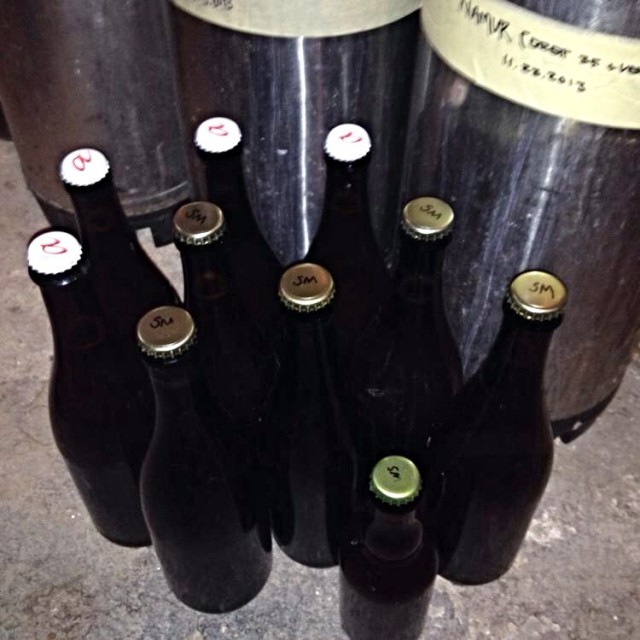
One thing to add is that this was also my first chance to use my custom "ambrosia" caps, which Amy got me for Christmas:

Difficult to see, but ambrosia "a" logo caps on the left.

Thursday, December 12, 2013

Calculating Slurry Volume for Starters

Earlier tonight -- two days prior to my upcoming Namur brew day -- I made a starter using a portion of the cake harvested from Batch 02 on November 23, 2013.  As I don't have the proper equipment for properly measuring cell counts, I did a workaround that should hopefully be sufficient for now.  To do this, I utilized YeastCalc.

First, I put in my harvest date and OG into YeastCalc, which told me that I needed 175 billion cells.  I then changed my initial starter volume (no aeration) to 1.0 L.  After fiddling with the numbers in the "Liquid Yeast Properties" box, which is where I initially found my viability percentage, I discovered that having an initial cell count of 160 billion would give me 131.19 billion viable cells, which would then yield 175 billion viable cells with the 1.0 L starter.

Once I knew that I would need 160 billion cells from my population, I used the measurements provided by Wyeast for repitching to determine my cells per mL of slurry.  This indicated that there are 1.2 billion cells per mL when the slurry is 40-60% solids.  I estimated my slurry (below) to be 75% solids, so I figured that I had roughly1.8 billion cells/mL.  Doing the math to get to 160 billion cells, I determined that I needed 88.89 mL of slurry from the jar, and that's what I pitched into the starter.


Slurry from Namur (Batch 02) in a 500mL mason jar.


I realize that this method is pretty crude and relies on a lot of estimates, so I have some bigger plans for the future.  My initial thought, and we'll see how this works out, is that I will take two test vials of White Labs yeast.  Given that these purportedly contain roughly 100 billion cells, I will empty these into a coffee filter to drain out the liquid.  I'll then take measurements of the weights of the resulting yeast, and determine the weight of 100 bill cells without any trub, averaging the weights from each vial.  From there, I can then drain out my yeast cakes in the same manner and determine pitching rates based on weight.

Tuesday, December 10, 2013

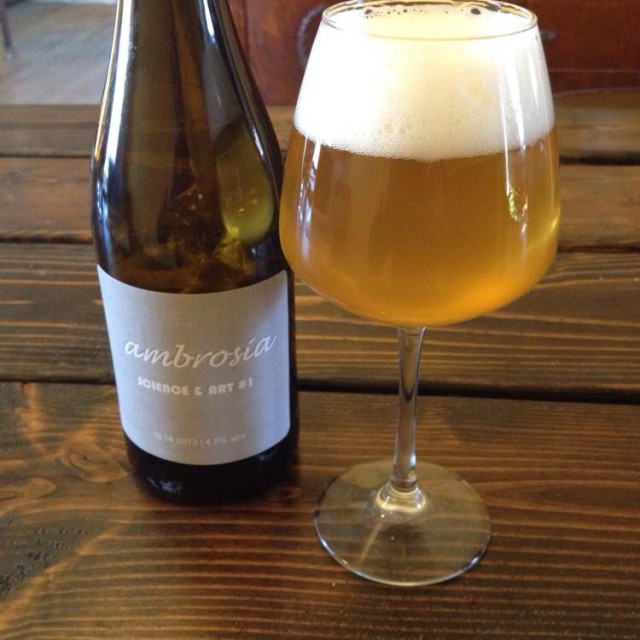
Science & Art #1: Tasting Notes

Below are the tasting notes for Science & Art #1, a blend that I created by using approximately 85% Farmhouse Mild and 15% Citrine (Batch 4).  I've wanted to start blending my saisons and wilds, and this seemed like a good place to start.  I had both beers on hand and ready to go, so I decided to mix at various ratios to get to an easy-drinking blend.  I wanted the fruit and wheat notes from Farmhouse Mild to dominate, following up with just a bit more acidity and minor funk from the Citrine.

At that point, all I needed to do was come up with a name.  I wanted something that I could keep around for awhile, as with these blends, I thought it would be easier to go with a standard name followed by numbers or years, such as Lost Abbey Veritas, Hill Farmstead Civil Disobedience, and Cantillon Zwanze.  Given that these beers will be blends of wilds and saisons, I thought "Science & Art" would be appropriate.  One of the things I love about brewing, and particularly about saisons, is that there is so much room for creativity.  However, at the same time, there's still the base science behind beer making and, most importantly for my purposes, fermentation.  


Appearance: A bright, faint yellow color with a large, fluffy white head. Great retention, with the head eventually falling down to a thin cap. Plenty of lacing on the glass. Pretty clear with visible carbonation.

Aroma: The initial nose has a touch of sulfur. Enough to be noticeable, but not distracting. This is something I actually like to have a bit of in my wild beers, similar to what I've found in Sahalie from Ale Apothecary. With that said, I know that this is often heavily present in my Berliner Weisse beers and then dissipates, so I'll have to find out the cause and whether that will be true here. Maybe it's something caused by the bottle conditioning process, as neither of the beers used in blending this beer had any sulfur.

Aside from that, there's a light bit of lemony citrus and some faint barnyard funk.

Flavor: The flavor continues from the nose, with a nice zesty acidity carrying through the finish. Some lactic, but more of a citric acid feel. A bit of wheat there, as well as a very mild tropical fruit note. While Farmhouse Mild was quite tropical and Sweet Tart-like, this takes on more of the citric feel of Citrine, even with Citrine only being 10-15% of the blend.

Mouthfeel: Lingering dryness after a light body and spritzy carbonation. Similar to Farmhouse Mild, this is very easy drinking. The acidity keeps the quaffability a little bit in check, though the lighter body makes this more drinkable than the slightly-fuller body of Farmhouse Mild.

Overall: I'm pretty pleased with the blend, and am curious to see where it goes over time.  Right now it's fairly bright, fruity, and lactic.  I'm curious if it'll become a bit more rustic and funky over time.