Wednesday, May 21, 2014

Farmhouse Mild (Lemon Guava): Tasting Notes


This beer started as a portion of the third batch of Farmhouse Mild that I brewed back in December.  The beer had a bit of a pedio issue, kicking up a lot of diacetyl.  Since it was going to take the Brett a bit to take care of that, I figured I might as well experiment with some fruit that I'd been wanting to try.


Over the summer, I had frozen 5 pounds of chopped lemon guavas, which I find to be highly enjoyable.  They're about the size of a lime, and are a pale yellow, with a "burst" at one end:


The flavor is fantastic.  A combination of lemon and guava, with a bit of pineapple thrown in.  Very tropical, and lightly tart.  The inside has small and hard (yet edible) white seeds.

I let transferred the Farmhouse Mild over to a keg on top of the 5 pounds of chopped, previously frozen fruit, filled the headspace with CO2, and let them sit for about two months.  I got the beer on tap in early March, but am just now finally getting around to posting tasting notes.


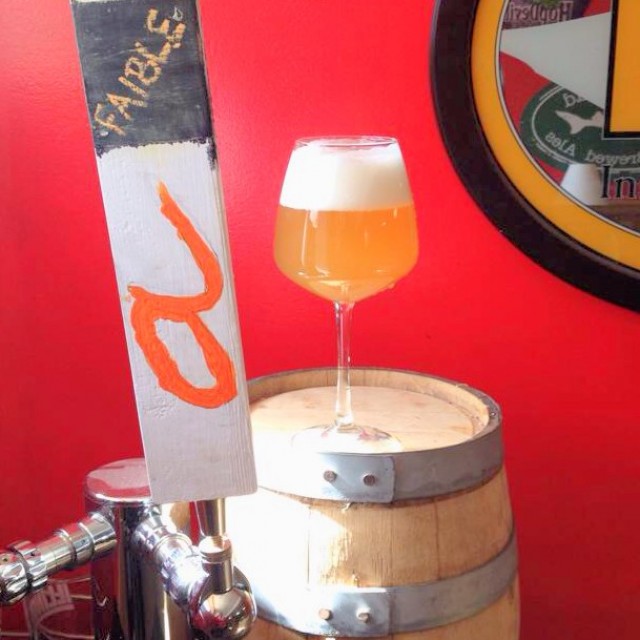
Appearance: Hazy bright yellow. Shiny with a fluffy white head. Short retention time with little lacing.

Aroma: Nose is bright guava with hints of pineapple and nice backing lemon. Fruit skin hits there as well. Bit of backing wheat, though the overall grain presence is fairly minuscule.

Flavor: Lemon, guava, light acidity, and a bit of fruit skin. Very faint tannin. Lemon guava in liquid form with a bit of extra pineapple and extra acidity. Mild Brett C induced funk in the background. Can just barely taste the wheat.

Mouthfeel: Very light and crisp. Strong carbonation. Extremely easy drinking. Tartness is more than noticeable, but not quite sour. Berliner level in that regard. Low alcohol making it excessively quaffable.

Overall: One of the best beers that I've done to date. At this point, really can't think of how I would change this up too much. Would perhaps up the sodium and chloride levels up just a touch in the water profile, and maybe use a little more wheat, or change up some of the existing flaked wheat unmalted wheat. Maybe 5% or so of oats, enough to give just a bit more body without taking away from the drinkability.

Tuesday, May 20, 2014

Namur (Batch 03): Recipe

A bit behind on the posts lately, having been busy with work and getting our garden up and running.  Hopefully the latter translates into plenty of backyard produce being used in my beers over the next few years.  I'll surely find a thing or two that will be ready for use later this summer or in the fall, but am really looking forward to being able to use a wide variety of fruits as those plants progress over the next few years.  At the very least, I'll have plenty of herbs to experiment with in saisons this year.  Over the next few days, I should have up a good number of tasting notes posts, as well as at least three more recipe posts.

This was my third time brewing Namur.  I figured this would a good time to test out the three Yeast Bay saison strains/blends that I'd ordered, as well as East Coast Yeast's Farmhouse Brett (Saison Blend).  From The Yeast Bay, I had Wallonian Farmhouse, Saison Blend, and Saison/Brettanomyces Blend.  I brewed up a 10-gallon batch alongside a late-boil charge of Belma, hoping for nice yeast complexity and a bit of citrus and fruit from a relatively-pungent hop variety.


Here are the full details on the new batch:

Batch Number: 82

Brew Date: March 15, 2014.
Bottle Date: 04.13.2014 (clean strains) and 04.30.2014 (Brett portions)
Batch Size: 10 Gallon
OG: 1.048
FG: Varies (see below)
Fermentation Temperature: 70-72* F
IBU: 28.5
ABV: 5.9%
SRM: 3.4

Mash: Single infusion for 60 minutes at 149* F
Boil: 60 minute

Fermentables

11.0 lb Dingeman's Belgian Pilsner
5.0 lb Wheat, Flaked
2.0 lb Rice, Flaked
1.0 lb Acid Malt

Salts & Water

4.0g Calcium Chloride (all into the kettle)
1.0g Gypsum (all into the kettle)
3.0g Sodium Chloride (all into the kettle)

Mash pH should have been right around 5.4-5.45, though I didn't take a measurement this time.

Resulting water profile is as follows:

Mash pH (est.): 5.43
Calcium: 59
Magnesium: 12
Sodium: 48
Chloride: 84
Sulfate: 38

Hops
5mL HopShot at 60 minutes
4.0 oz. Belma (11.6 AAU) at flameout

Other

2.0 tsp. Wyeast Yeast Nutrient at 10 minutes (double the normal amount to provide extra FAN, per the suggestion in Phil Markowski's Farmhouse Ales)


Yeast

Yeast Bay Wallonian Farmhouse
Yeast Bay Saison Blend
Yeast Bay Saison/Brettanomyces Blend
East Coast Yeast Farmhouse Brett (Saison Blend)

For expiration dates, the Yeast Bay Wallonian Farmhouse had a best by date of 06.17.2014, and pitched full vial into 2 gallon portion, no starter.  The Yeast Bay Saison Blend had a best by of 06.17.2014, and pitched full vial into 2 gallon portion, no starter.  The Yeast Bay Saison/Brettanomyces Blend had a best by date of 08.17.2014, and pitched full vial into 2 gallon portion, no starter.  East Coast Yeast 03 has a prep date of 02.03.2014.  Given the volume of the ECY "vials," I used only half of the vial into the 2 gallon portion.

Notes

03.15.2014 Brew day.  20 seconds of pure oxygen to each.  After 12 hours, small krausen on each and sitting at 67 degrees.  Bumped controlled up to 72F with temperature differential set at 2.  Should stay around 70.

04.05.2014: Moved from water bath to room temperature area to make room for Batch 083.

04.13.2014: Bottling day.  The Wallonian portion was a bit over 2 gallons, and received approximately 52g of priming sugar mixed in heated water, aiming for 2.7 volumes.  Yield is 14 500mL bottles.  FG is 1.004.  Taste is very smooth.  Lots of mango and other tropical fruit with a hint of tangerine.

04.30.2014: Bottling day for the Brett portions.  The Yeast Bay Saison/Brett portion is also over a bit over two gallons, so using approximately 52g of priming sugar with heated water to get at 2.7 volumes.  Yield is 14 500mL bottles.  FG is 1.002.  The East Coast Yeast 03 portion is also over a bit over two gallons, so using approximately 52g of priming sugar with heated water to get at 2.7 volumes.  Yield is 14 500mL bottles.  FG is 1.001.

Sunday, February 23, 2014

Ruby (Batch 03): Recipe

This is my third time brewing Ruby, my Flanders Red Ale. The first batch was done in April 2012, and eventually was aged in a whiskey barrel. Unfortunately, this batch pre-dated me posting recipes, though hopefully I'll get tasting notes up for that eventually. The second batch was done in April 2013, and was bottled yesterday. I was really lax with notes on that one, as it was done right before we moved from Alexandria, Virginia back to Chicago last spring, so no post on that one either.

This recipe is quite similar to the base for the previous two, though this time I'm substituting in flaked maize for most of the wheat. I'll be using Roeselare for the entirety of this one, although may add dregs along the way. The first batch also used Roeselare and turned out quite well. The second batch was done with East Coast Yeast Flemish Ale (ECY02), courtesy of my friend Joe. Similar to batch 1, I will hopefully add in tasting notes for that one at some point.

The recipe for the full batch is as follows:

Batch Number: 81
Brew Date: February 23, 2014
Bottle/Keg Date:
Batch Size: 10 Gallon
OG: 1.050 (estimated)
FG: 1.002 (estimated)
Fermentation Temperature: ~65 F (ambient)
IBU: 19.1
ABV: 6.3% (est.)
SRM: 15.6

Mash: Single infusion for 60 minutes at 156 F.
Boil: 60 minute

Fermentables

9lb French Pilsner
4lb Munich Malt
2lb 8oz Maize, Flaked
1lb Wheat, Flaked
1lb Caramunich Malt
1lb Special B Malt
8oz Aromatic Malt
8oz Vienna Malt

Water 
Mash Water: 6.6 gallons 
Sparger Water: 7.7 gallons

Here, I added lactic acid to get the mash pH where I wanted it, and added enough calcium chloride to get the calcium level up past the recommended minimum of 50.

5.0g Calcium Chloride (all added directly to the kettle)
5mL Lactic Acid (88%) in the mash

Resulting water profile (based on EZ Water Calculator v3) is as follows:

Mash pH (est.): 5.44
Calcium: 59
Magnesium: 12
Sodium: 7
Chloride: 59
Sulfate: 27

I used lactic acid to adjust the pH of the sparge water, adding 5mL to the 7.67 gallons of water used for the sparge, which basic on the Homebrewing Physics calculator (available here), should give a sparge water pH around 5.0.

Hops
1.5oz Willamette (7.5 AAU), leaf, at 60 minutes

Other

2 tsp. Wyeast Yeast Nutrient at 10 minutes

Yeast

Wyeast Roeselare (1 packet for each 5-gallon portion)

Notes

02.23.2014: Brewday.  Each carboy got 30 seconds of pure O2.  The Roeselare packets were from October 29, 2013 and December 3, 2013.  I mixed them in a sanitized measuring cup and split evenly between the carboys.

07.28.2014: Took one of the carboys out to the garage for a bit of mixing.  The beer was moderately acidic, with a light lactic character along with a nice berry presence. Gravity was down to 1.008, and pH was 3.8. 3 gallons of it were added onto 6 pounds of black raspberries that we had picked in Michigan (and subsequently froze) over Fourth of July weekend, all into a 3-gallon Better Bottle.

The remaining portion was included in a blend for Science & Art #5.

Picking black raspberries in Southwest Michigan.
Also found a baby bird.


Adding the black raspberries to the carboy.

Nice and purple.

08.04.2014: After coming back from a nice weekend camping in Northern Michigan, the fermentation on fruit had really taken off.  The liquid in the airlock was light purple, and a bit had spilled over onto the garage floor.  Temperature during this time likely ranged from 70-75*F.

There was plenty of fruit pulp at the top that was not submersed in liquid.  Fearing any sort of acetobacter infection due to exposure to oxygen, I utilized the "punch down" technique to get the berries back into liquid, and then replaced with a clean airlock.  The punch down technique has been described on several occasions by Jester King, including here:
The blackberry refermentation involved a traditional wine making practice called a “punch down”. As the blackberries referment, they rise to the top of the oak barrel to form a cap. Several times a day we punched down the cap with a stainless steel mashing tool to break it up. This procedure was important to achieve good flavor and color extraction from the blackberries and to prevent the cap from drying up and becoming oxidized, which can lead to unwanted growth of acetobacter. Acetobacter, while harmless to consume, creates vinegary flavors and aromas that we dislike very much in beer. Punch downs and temperature control in our barrel room were important parts of our effort to keep acetobacter at bay.
11.01.2014: Was aiming to bottle the black raspberry version -- now named Amethyst -- but I had a ton of problems trying to bottle this with the Beer Gun out of the keg.  So now it's sitting under pressure with the bottling sugar, conditioning in the keg.  Based on this, it looks like I'll serve the beer on tap.  In the future, I think fresh juice might be the way to go for raspberries and blackberries.  They simply fall apart when left to ferment, and I'm not sure there's any benefit to having the whole fruit, as there isn't a pit or tannic skin to provide much additional flavor.

Saturday, February 22, 2014

Saison Faible: Tasting Notes

Saison Faible is the clean petit saison that I brewed for the first time recently, using solely Saccharomyces as opposed to the blend of Saccharomyces, Brettanomyces, and bacteria that is used in my rustic saison, Farmhouse Mild.  Of course, I can never entirely get away from wild fermentations, so I took the other 5-gallon portion of this batch and fermented it with Ambrosia Blend 003, which utilizes the grown up dregs from a bottle of the November 2013 batch of Hill Farmstead Anna.

This batch of Faible was fermented with East Coast Yeast Saison Brasserie Blend (ECY08), which is described as "both fruity and spicy characteristics accompanied by dryness." It was hopped with Calypso, Citra, and Simcoe.


Appearance: Hazy golden color with just a touch of a peach hue.  Dense, rocky white head with good retention and plenty of lacing as it fades down to a thin cap and collar.

Aroma: Slight tropical fruit notes along with some bread dough.  A very slight hint of bubblegum.  Some mild pear and honeydew.  

Flavor: Juicy Fruit is what immediately comes to mind for me.  Tropical fruit and very light orange peel in the background.  Honeydew and melon.  A touch of pepper and a very mild lingering bitterness in the background.  Dry with a hint of tartness through the finish.  As it warms, there's a touch of bread dough in the background.  I've noticed quite a bit more of the bread dough if I have nearly any other beer ahead of this one.

Mouthfeel: Light with effervescent carbonation.  Just enough body to keep it from seeming thin.  A slight lingering bitterness through the finish.  Very faint pepper in the aftertaste.

Overall: I'm very pleased with how this one came out, especially with it being my first time using this strain/blend.  I'm very curious to see how this is going to perform in subsequent generations, as well as with a bigger beer.  I of course had to mix it with something wild, so I am already using the second generation of this blend, combined with Brett C and Brett Trois, in the new batch of Demeter Auran.

Ambrosia Yeast Blends

Rather than trying to keep track of all the separate dreg and commercial strain blends that I've done in miscellaneous posts, I thought it would be useful to keep track of each blend across generations.  Also, instead of describing each blend again in each individual recipe post, I can simply link back to this post.

Ambrosia Blend 001 (AMB001)

Created from a blend of Wyeast 3725 (Biere de Garde), Crooked Stave, and mixed-ferment saison dregs.  Ferments at relatively low temperatures and displays extreme citrus and tropical fruitiness with a bit of funk and light acidity.  Additional saison dregs from AMB003 (see below) were added at the fourth generation.

Generations:

1.   Farmhouse Mild (Batch 03) (September 20, 2013): Petit rustic saison brewed with a generous               helping of American hops.  Half of this batch was blended with some Citrine (Batch 04) to create 
      Science & Art #1.  The cake from this was used to ferment:

2.   Demeter Spectre (October 25, 2013): Saison brewed with miscellaneous spices and the juice of             peaches, strawberries, and raspberries.  The cake from this was used to ferment:

3a.   Demeter Sinis (Batch 02) (December 14, 2013): Dark saison with black cardamom and lavender.          5 gallons of the batch was fermented was pomegranate, and the remaining 2-gallon portion was              fermented with fresh cranberries.

3b.  Namur (Batch 02) (December 14, 2013): Blonde saison with AMB001 being used to ferment                separate 2-gallon portions with Meyer Lemons and Satsuma Mandarins.

4.   Farmhouse Mild (Batch 04) (February 2, 2014): Petit rustic saison brewed with barley, wheat, oats,       rye, and spelt.  Hops for this batch are Belma, Simcoe, and Amarillo.

Ambrosia Blend 002 (AMB002)

Blend of East Coast Yeast Saison Brasserie Blend (ECY08), White Labs Brettanomyces Claussenii (WLP645), and White Labs Brettanomyces Bruxellensis Trois (WLP644).

Generations:

1.  Demeter Auran (Batch 03) (February 17, 2014): Blonde saison with blood orange zest, rose hips,          and plenty of Citra hops (split batch).

2. Bauernhof (June 1, 2014): No boil Berliner Weisse base fermented with the Ambrosia Blend 002 as       well as Jolly Pumpkin Calabaza Blanca dregs.

Ambrosia Blend 003 (AMB003)

Created from the dregs mixed-ferment saisons.

Generations:

1.   Saison Faible Wild (January 20, 2014): "Clean" petit saison, in contrast to the rustic Farmhouse             Mild. This half of the batch, however, is "wild" given all the critters used to ferment the saisons.

2.   Demeter Auran (Batch 03) (February 17, 2014): Blonde saison with blood orange zest, rose hips,          and plenty of Citra hops (split batch).

Ambrosia Blend 004 (AMB004)

Created from a mixture of Wyeast 1056 (American Ale), Lalvin 71B-1122 (White Wine Yeast), White Labs Brettanomyces Bruxellensis Trois (WLP644), and White Labs Brettanomyces Claussenii (WLP645).

Generations:

1.   Bitter Beer Face (Wild) (February 9, 2014): Hoppy pale ale fermented with a Brett culture.

Ambrosia Blend 005 (AMB005)

Created from a mixture of Yeast Bay Wallonian Farmhouse, East Coast Yeast Farmhouse Brett (Pure Strain) (ECY03-B), and Ambrosia Blend 002.

1.     Demeter Vert (Batch 03) (June 21, 2014): Blonde saison with lime juice and zest, hopped with Sorachi Ace.

2.   Farmhouse Mild (Batch 05) (July 6, 2014): Petit saison brewed with barley, wheat, and rye; hopped with Simcoe.

3.     Wallonian Pale Ale  (Batch 02) (July 27, 2014): Hoppy saison with Mosaic, Citra, and Belma.

4.   Demeter Automne (August 10, 2014): Pumpkin saison with cinnamon, ginger, nutmeg, and allspice, half of which is destined to be blended with a wild cider and Citrine to become part of the Science & Art series.

5.     Wallonian Pale Ale (Batch 03) (August 23, 2014): Re-brew of the July 27, 2014 version of WPA with some slightly-different hops.  I taught a friend to brew and he wanted a pale ale, so I fermented his half with London Ale III, and my half with the cake from Demeter Automne.

6.     Demeter Facile (September 27, 2014): Blonde saison using the cake from the August 23, 2014 batch of Wallonian Pale Ale.  Pretty basic recipe designed to let the yeast shine through.

7a.     Demeter Sinis (October 4, 2014): Dark saison using the cake from Demeter Facile.  Spice with a bit of lavender and black cardamom.

7b.     Wallonian Pale Ale (Batch 04): Hoppy saison with Mosaic, Belma, and Galaxy.

Note: As I won't be brewing for quite a bit of time due to the forthcoming Thorpe twins, I saved plenty of the cake of Demeter Facile for use in future batches.  I'll have to revive it a few times during the brewing hiatus, or maybe get a small indoor batch done over the winter.

2016 update: I revived this blend using a combination of an old cake and dregs from beers fermented with this blend, and now use it to ferment most of my beers.  If I want something that's fruity, slightly funky, and a bit acidic, then I use this.  When I want a saison that's initially clean but will develop some additional character over time, I ferment with a commercial saison strain and add just a bit of this as well.

Ambrosia Farmhouse Mild (Batch 04): Recipe

This is now my fourth time overall brewing Farmhouse Mild.  Most of the recipe is the same, but this time I also added a bit of raw spelt to give the recipe a little more of a rustic flare.  The spelt was not cereal mashed.  I had also run out of Munich, so this time I used a little Aromatic and Vienna instead.  Finally, for a bit more color, I added a bit of CaraMunich.

For the hops, this was my first time using Belma, which should give a nice fruitiness to the beer, as the HopsDirect website describes the hop as follows: "very orange, slight grapefruit, tropical pineapple, strawberry, and melon aroma."
The recipe for the full batch is as follows:

Batch Number: 78
Brew Date: February 2, 2014
Bottle/Keg Date:
Batch Size: 10 Gallon
OG: 1.044 (estimated)
FG:
Fermentation Temperature: 65 F
IBU: 25.2
ABV: 5.6% (est.)
SRM: 5.9

Mash: Single infusion for 60 minutes at 154 F.
Boil: 60 minute

Fermentables

6lb 8oz French Pilsner
4lb White Wheat Malt
2lb Wheat, Flaked
1lb Spelt, Raw
1lb Vienna Malt
14oz Acidulated Malt
8oz Aromatic Malt
8oz CaraMunich Malt
8oz Oats, Flaked
8oz Rye, Flaked

Salts & Water

5.5g Calcium Chloride (all added directly to the kettle)
2.8g Gypsum (all added directly to the kettle)

Resulting water profile (based on EZ Water Calculator v3) is as follows:

Mash pH (est.): 5.40
Calcium: 70
Magnesium: 12
Sodium: 7
Chloride: 59
Sulfate: 53

I used lactic acid to adjust the pH of the sparge water, adding 5mL to the 9 gallons of water used for the sparge.

Hops

5mL HopShot at 60 minutes (25.2 IBUs)
2oz Belma (11.6 AAU), at flameout
1oz Simcoe (13.0 AAU), at flameout
1oz Amarillo (8.5 AAU), at flameout

Other

2 tsp. Wyeast Yeast Nutrient at 10 minutes

Yeast


Notes

02.02.2014: Added 5mL of 88% lactic acid to the 9 gallons of sparge water to achieve a sparge water pH of 5.6, using the sparge water acidification measurements provided in the spreadsheet available from Homebrewing Physics: http://homebrewingphysics.blogspot.com/2014/01/mph-water-calculator-v12.html.

Measured mash pH of 5.5 at roughly room temperature.

Used cake from 01.05.2014 batch (unrecorded; lost notes).  133mL to each bucket after 30 seconds of oxygen.  Loose lids.  Chilled to upper 60s.  OG is 1.047.

02.04.2014: Very strange fermentation here.  Looks very slightly ropy on the top after 48 hours.  At 36 hours, there were visible CO2 bubbles rising to the top and the gravity was down to 1.044.  At 48 hours, there still is no krausen, but there are visible bubbles and it's down to 1.039.

02.05.2014: Ended up adding a wine thief or two full of the batch with HF Anna dregs to each bucket, and 12 hours later a krausen had started to form.  24 hours later, at full krausen underneath the Brett pellicle.  Very interesting look.

Wednesday, February 19, 2014

Demeter Auran (Batch 03): Recipe

This is now the third batch of Demeter Auran, and the first I've done fermenting with something other than my initial mixed-ferment saison dreg blend.  For this 10-gallon batch, half is being fermented with the second generation of grown up dregs from a few commercial saisons.  The other half is being fermented with a blend of East Coast Yeast 08 (Saison Brasserie Blend) and Brettanomyces Claussenii and Brettanomyces Bruxellensis Trois.

The recipe for the full batch is as follows:

Batch Number: 80
Brew Date: February 17, 2014
Bottle/Keg Date:
Batch Size: 10 Gallon
OG: 1.050 (estimate)
FG:
Fermentation Temperature: 79 F.
IBU: 29.2
ABV: 6.3% (est.)
SRM: 4.3

Mash: Single infusion for 60 minutes at 148 F.
Boil: 60 minute

Fermentables

9lb 8oz French Pilsner
8lb Wheat, Flaked
2lb Munich Malt

Salts & Water

7.0g Calcium Chloride (all added directly to the kettle)

Resulting water profile (based on EZ Water Calculator) is as follows:

Mash pH (est.): 5.49
Calcium: 67
Magnesium: 12
Sodium: 7
Chloride: 73
Sulfate: 27

Hops

5mL HopShot at 60 minutes
3.0oz Citra (12.9 AAU), leaf, at flameout

Other

2 tsp. Wyeast Yeast Nutrient at 10 minutes
28g Blood Orange Zest at flameout
10g Rose Hips at flameout

Yeast

Saison dregs / Ambrosia Blend 003 (5 gallons)
East Coast Yeast Saison Brasserie (ECY08) plus Brett C & Brett Trois  / Ambrosia Blend 002 (5 gallons)

Notes

02.18.2014: At 12 hours, the temperature was only 62 F in the basement, so I set up a water fermentation "chamber" in a large plastic tub.  I have an aquarium heater attached to a temperature controller.  I set the controller to 70 F with a differential of 2 degrees.  At 24 hours, the temperature was up to 68 F.  I upped the controller set temperature to 71 F.  The ECY & Brett portion is bubbling away, but nothing on the saison dreg portion yet.

02.19.2014: At 36 hours, controller says the temperature is 70 (temperature of the fermenting beer itself is the same).  Both are bubbling quite a bit.

03.01.2014: The version with Anna dregs has a sulfur taste just like the Saison Faible portion with this blend did.  I don't want to take any chances on 5 gallons, so I decided to make it a bit funky and added a wine thief full of fermenting Citrine (blend with lambic dregs previous Citrine dregs) to the bucket.

03.03.2014: Decided to create something I've wanted to try for a long time now, which is a passion fruit saison.  Since passion fruit is such a strong flavor, I wanted to keep it relatively subdued.  Thus, I added 28oz. of passion fruit puree to the Ambrosia Blend 002 portion of the batch, first saving a "clean" portion of the cake by filling a mason jar with a few wine thief pulls full of as much of the cake as I could get.  The puree was still a bit of a slush, so I added it through a funnel with the bottom of the funnel inside the liquid, attempting to limit any oxygen exposure.

03.16.2014: 23 bottles.  Aiming for 2.5 volumes.  122 grams of table sugar in 5 gallons of beer.

07.20.2014: Finally ready to do something with the portion that had grown up Anna dregs.  After adding the Citrine dregs, it has calmed down a bit, losing sulfur and is overall less funky.  To add another dimension other than the yeast, I added 84oz. of pink guava puree along with a thief full of the currently fermenting batch of Farmhouse Mild (Batch 05).  Hopefully this kick starts things.  I'm a bit worried about the temperature, as one of the 14oz bags of puree busted while thawing, so I ended up adding all of the guava as slush.